

A LOT of people think that:
- Scrum = Agile; and
- Agile = Scrum.
Scrum predates the Agile Manifesto. The Agile Manifesto was brought about in February 2001. The four values and a number of principles were then agreed a few weeks later. The Agile Manifesto has, more or less, stood the test of time. It was and still is called the Manifesto for Agile Software Development, often known as the Agile Manifesto.
It was originally designed for software development.
But if you change the words:
- “software” to “product” or “product development”; and
- “project” to “product” in the principles,
it still kind of works.
It's showing its age, but there have been a number of attempts to overcome the Agile Manifesto, BUT they haven't really taken route.
How did the Agile Manifesto come about? What does it encompass?
So, the Agile Manifesto explains what Agile is, and Agile has four values and 12 principles. 17 people were there at that skiing weekend when they created the four values for the Agile Manifesto.
To my knowledge, three of them were representing Scrum: Mike Beedle (who died in the last few years), rest in peace, Jeff Sutherland, and Ken Schwaber. They were the main protagonists, as far as I understand, for Scrum, but there were 14 other people there representing all sorts of other approaches.
So, what is the difference between Agile and Scrum?
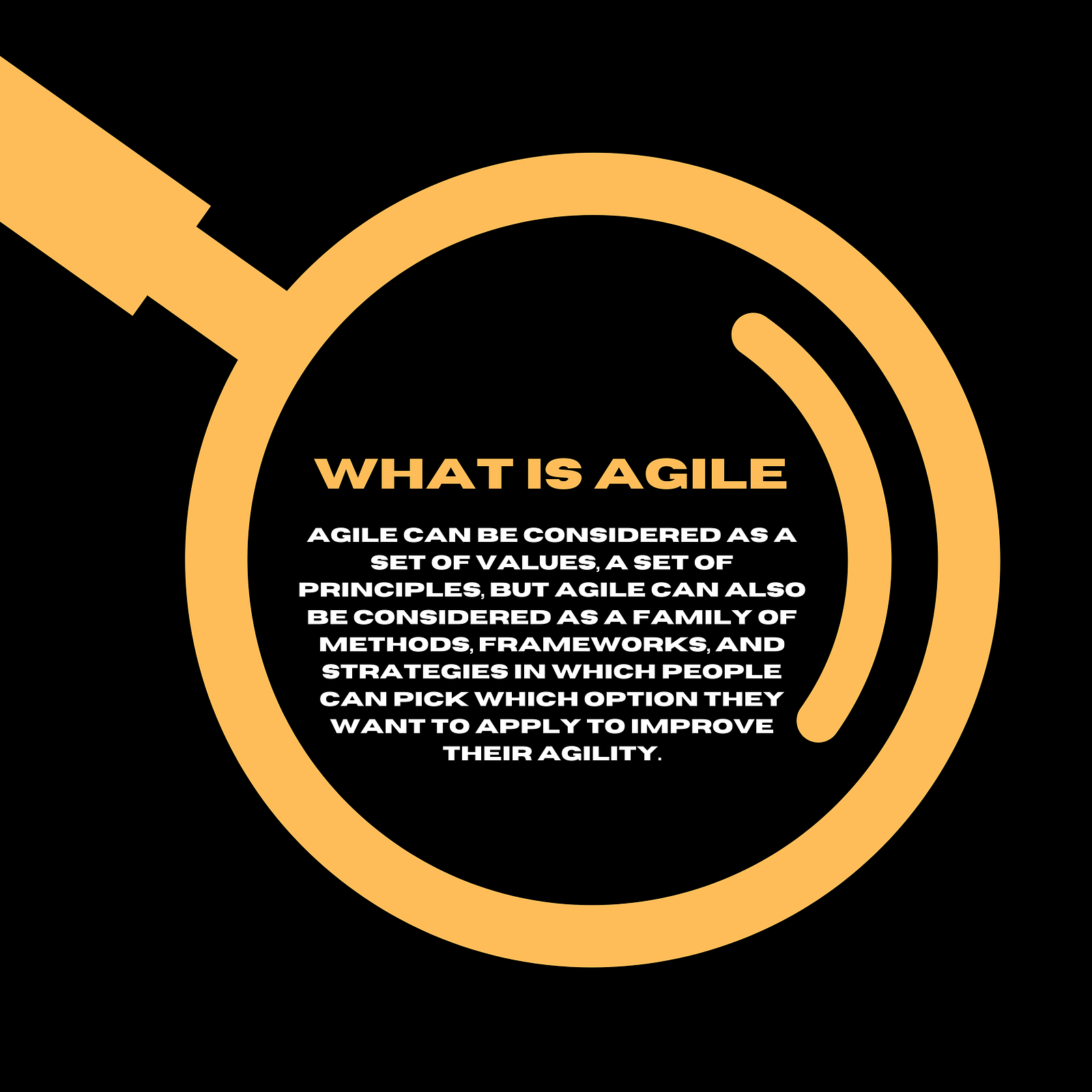
Agile can be considered as a set of values, a set of principles, but Agile can also be considered as a family of methods, frameworks, and strategies in which people can pick which option they want to apply to improve their agility.
So Scrum is only one of the options. It is probably the most popular option. Kanban and the lean methods are also catching up fairly quickly.
There's a lot of work in the problem management space that is similar to what people are doing in the agile space, EXCEPT there's more focus on discovery, getting customer data, and quantitative & quality data-informed decision making.
Is Scrum moving towards product management?
But for example, the more I see Scrum with UX developing, the more I see Scrum moving towards the product management space. There's still a lot of room for improvement.
In product management, they have product managers and product leaders. In Scrum, they have product owners and there's only one product owner for the product. We'll talk about that in another article.
A consolidated timeline of the evolution of Scrum and Agile
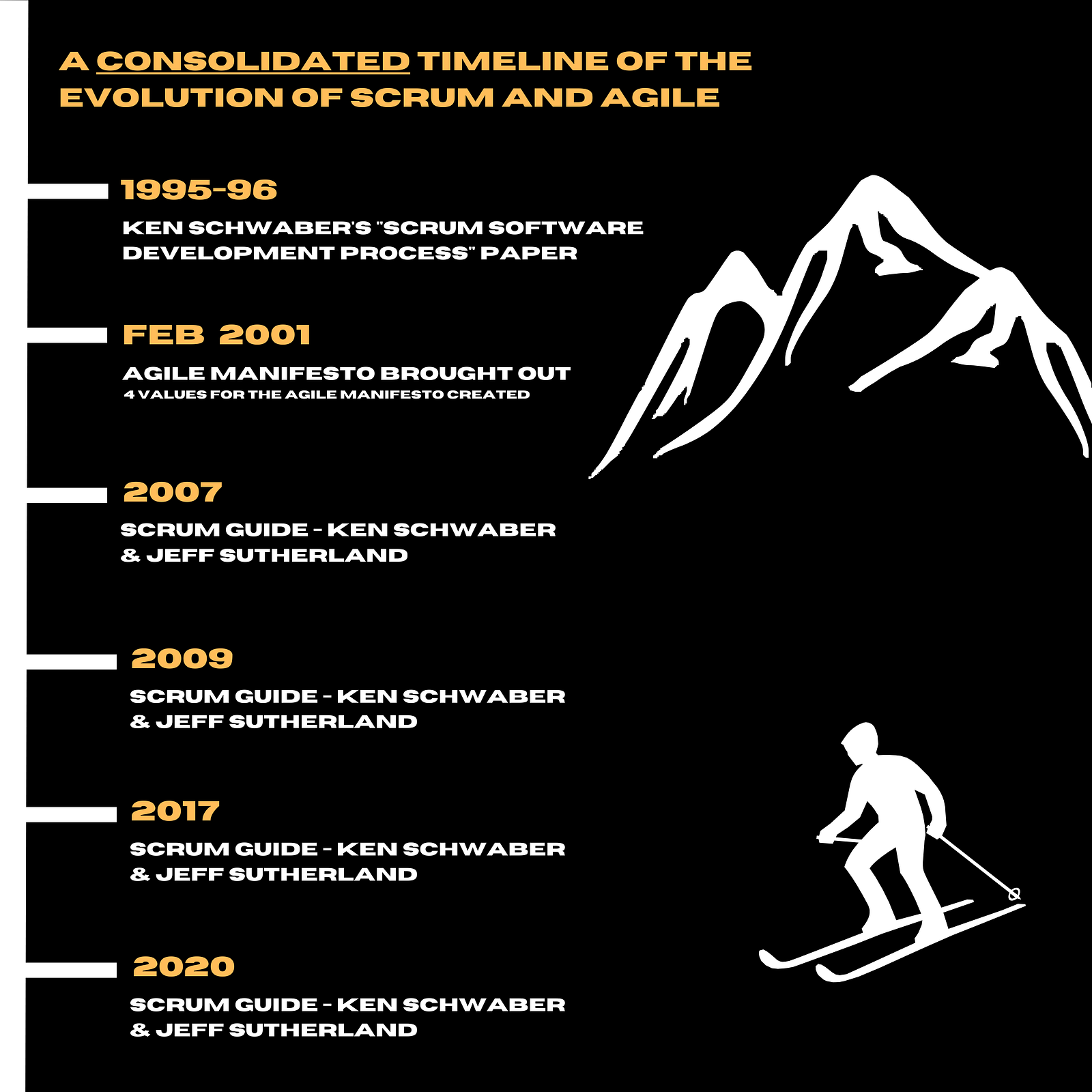
Scrum is just one option, and Scrum was formed in the early to mid-nineties. It was announced at an OOPSLA conference in the mid-nineties, and it has been iterated and evolved over the last number of years. There have been a number of versions of the Scrum guide, and the latest version is the 2020 Scrum guide.
There are lots of benefits to the latest version of the Scrum guide but there is a bit of a disconnect also in some communities, like for example, the large-scale Scrum (LeSS) community, which has actually disassociated itself in the 2020 Scrum guide and it has, instead, chose to stick to the 2017 Scrum guide.
What is a “product”?
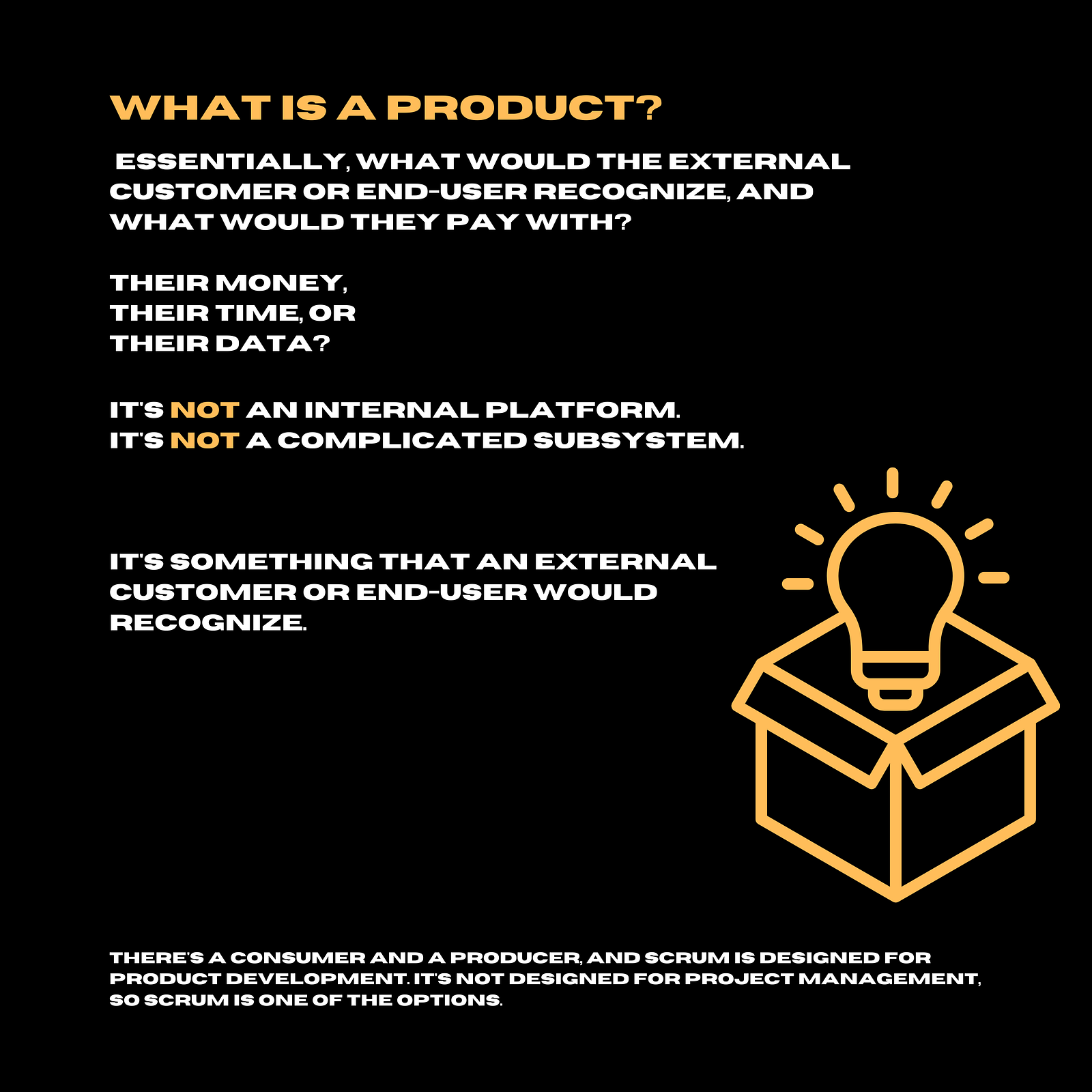
My personal opinion, even though I'm a LeSS-friendly Scrum trainer, is that the 2020 guide is a major step forward. I take the definition of product in the scrum guide with a pinch of salt, and I came up with my own approach, which I talked about in another article. Essentially, what would the external customer or end-user recognize, and what would they pay with? Their money, their time, or their data?
Is scrum for product development or project management?
It's a bit of an oversimplification, but that's how I define a product. It's not an internal platform. It's not a complicated subsystem. It's something that an external customer or end-user would recognize. There's a consumer and a producer, and Scrum is designed for product development. It's not designed for project management, so Scrum is one of the options.
Scrum is older than Agile
Scrum is older than Agile, actually. So it's funny when I hear people talking about returning to the Agile Manifesto. The Agile Manifesto postdates some of the methods, but there have been some new approaches since the Agile Manifesto. Kanban (as we know it now) for knowledge work, Lean Startup, Lean UX, and design thinking have developed a lot since 2001.
So, Scrum is just one of the options.
I want to mention one other important thing about Scrum. Scrum predates Agile. Scrum has been developed since Agile was developed. So you could argue it's got lots of elements of agile. Is scrum agile? That's a debate for another day.
Some people argue that it's not. Some people argue against frameworks, methods, and strategies.
The birth of Kanplexity
I personally think there is value in scaffolding for people. Not everybody can follow values and principles independently, and I've been known to create methods, frameworks, and strategies for teams. In fact, Kanplexity (Kanban for complexity) — was designed for exactly that purpose. For teams that actually couldn't use an option that was available and they and I felt that they needed something.
We won't get into that debate right now, and I fully support people who are involved in open agility as well, and I do get what they're doing. It's just that I do sometimes see the benefit of frameworks, strategies, and minutes, like Scrum.
The pillars of Scrum
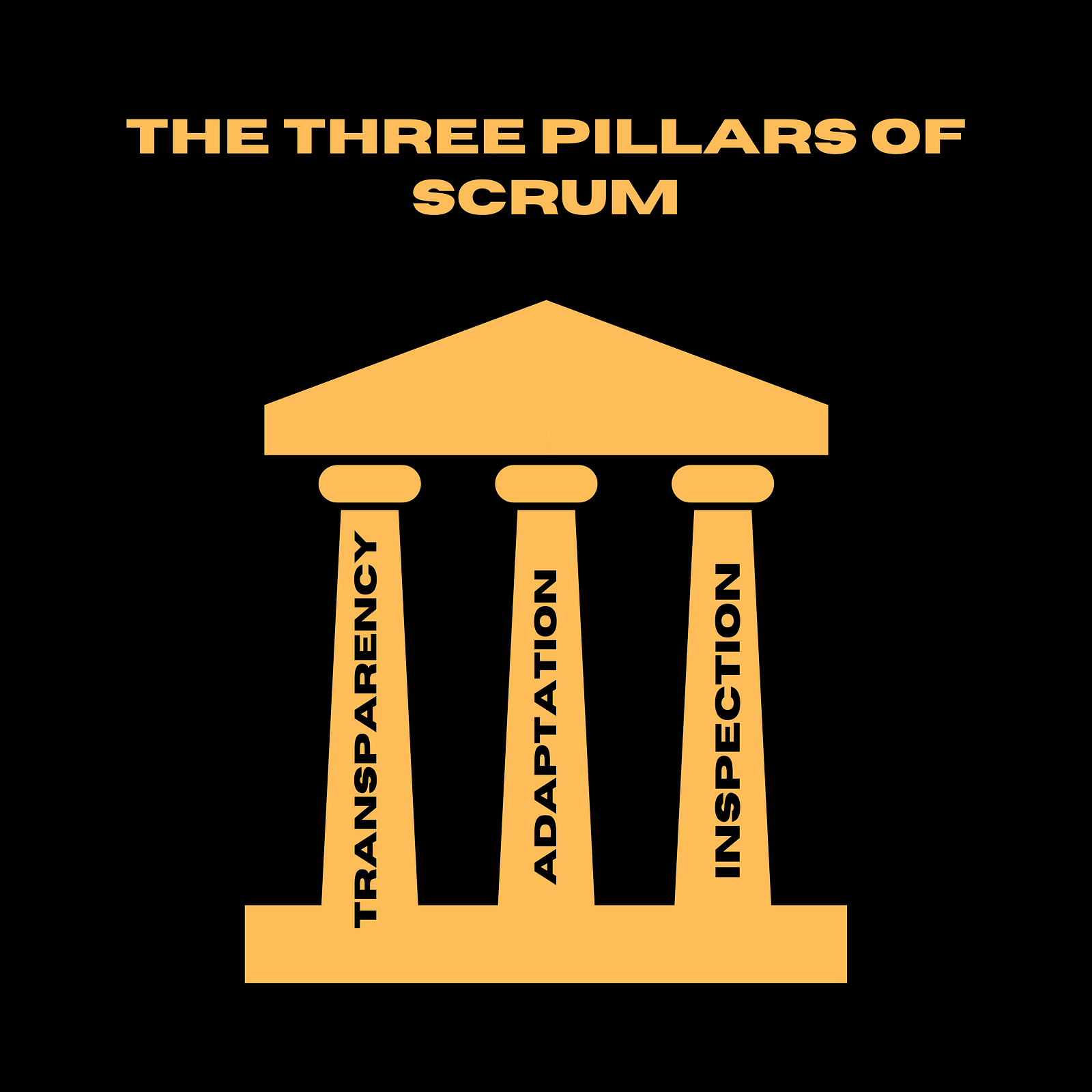
But the important point I want to make about Scrum, which was made really explicit in the 2020 Guide is Scrum is also based on empiricism or empirical thinking and lean.
Now, some people would argue that it's not really based on empiricism and empirical thinking. If you do a Google search on empiricism, you'll find very little about the three pillars of Scrum. They do seem reasonable.
The three pillars of Scrum:
- inspection;
- transparency; and
- adaptation.
Let's make decisions about what to do next based on the evidence and the learnings of what we did last. That seems reasonable.
So Scrum is strongly based on that, but it's also based on lean. So, there are some aspects of lean. So it is interesting that a lot of things go back to lean.
Couple that with the fact that we're also seeing lean Agile approaches. Now we've got Scrum with Kanban as well, so that's similar to lean Agile, isn't it? And then we've got Scrum with UX, which is like 21st-century lean because these would be the 21st-century variants of lean, where we're not just talking about manufacturing or getting work through the system quicker and knowledge work, but we're also trying to figure out, well actually, should we build anything?
Should we run some experiments and talk to customers to get evidence to see what we should build? So Scrum has grown up, particularly under the scrum.org umbrella, and with complimentary approaches like Kanban and Lean UX and other approaches, Scrum is becoming more agile than agile in many respects.
Concluding remarks
Scrum is based heavily on lean. Many Agile approaches do have some history in Lean, and essentially, in Scrum, we're trying to eliminate some waste. But Scrum is really designed for effectiveness over efficiency. Lean is really more about efficiency. The 21st-century Lean is more about effectiveness regarding whether we are building the right thing. Should we be running experiments to figure out what the right thing is to build?
Agility could be a combination of all of these things. It could be lean, agile, lean-agile, product management, DevOps, or modern agile.
Pick your approach, pick your set of values or your principles. Scrum is compatible with many of those and has common ancestors with Agile.
Thank you.
Share:
What is Evolved and why is it needed?